

At Super Productive, we work with all kinds of brains—neurodivergent, neurotypical, and folks who aren’t quite sure where they land on the neurodiversity spectrum.
And that’s the point.
Everyone thinks differently.
We realized this early on, when comparing how Jeff and Sarah (our two co-founders) approach their task lists.
- Jeff, who has ADHD, doesn’t want to see everything at once. That much input overwhelms his attention. He prefers to see just 3 key tasks at a time.
- Sarah, on the other hand, thrives on seeing the full list. She wants to scan the whole field and map out the terrain.
One system didn’t fit both minds.
And the differences didn’t stop there.
Some people on our team prioritize based on due dates.
They see what’s urgent.
Others prioritize based on what’s most impactful.
They see what’s important.
These two perspectives often clash. One person sees a looming deadline, while another sees a strategic priority.
So how do you build a system that respects both?
We took inspiration from the Eisenhower Matrix—an old but brilliant framework that separates tasks by urgency (how soon it’s due) and importance (how valuable it is). That’s when it clicked:
We needed a way to blend those two factors into a single, flexible system.
Introducing: The Hyperfocus System
The Hyperfocus System scores every task based on two things:
- Urgency: How close is the due date?
- Priority: How important is this task?
We use a grid similar to the Eisenhower Matrix, but tailored to our needs and with greater detail.
- Urgency is scored as Small, Medium, Large, or XL depending on proximity to the deadline.
- Priority is scored as Low, Medium, High, or Top depending on impact.
Each task gets a score based on both values, placing it into one of five categories:
- Due: Urgent + Important — Do this now.
- Queue: Important, but not urgent — Plan this next.
- Review: Urgent, but low importance — Reassign or revisit.
- Ignore: Low urgency + low priority — Let it go.
- New: No due date or priority yet — Needs clarity.
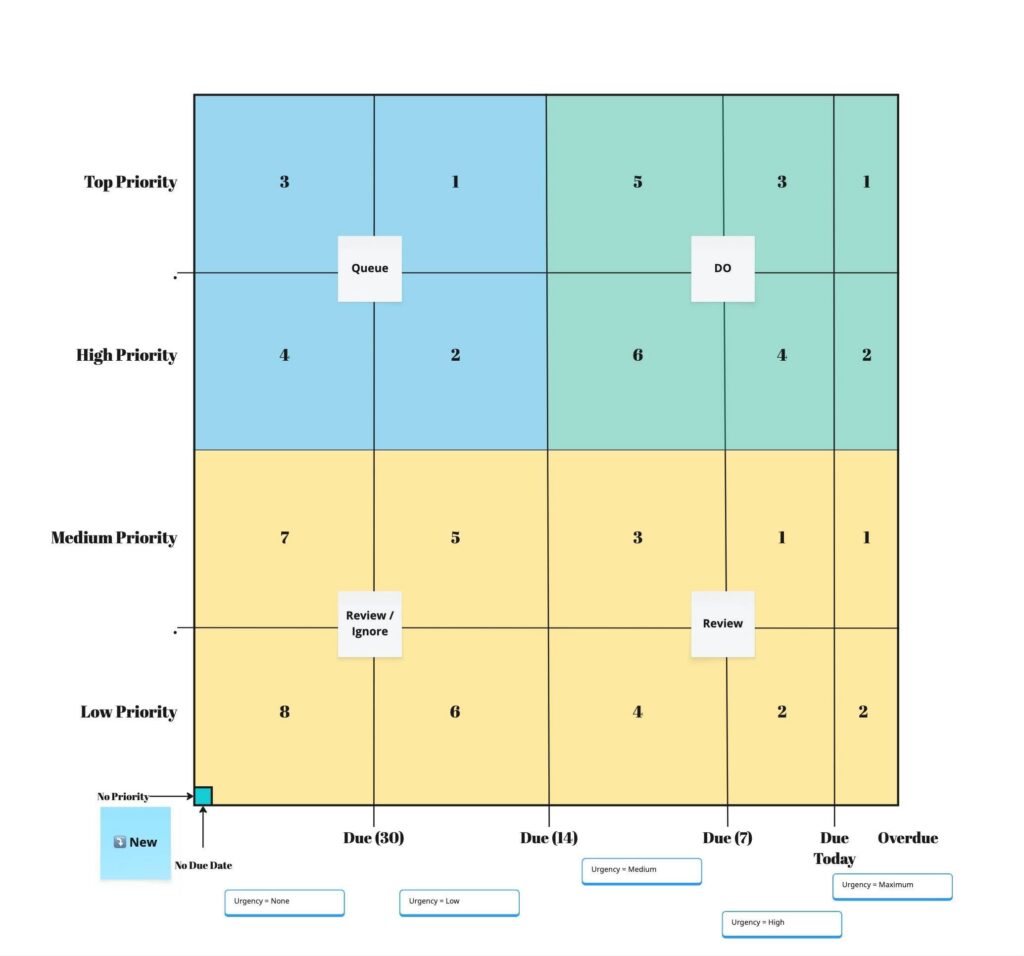
And here’s the best part: it’s fully automated.
We built it using the Asana API, so tasks update themselves as deadlines shift or priorities change. Everyone on the team can now see, instantly, what to work on, no matter how their brain prefers to sort information.
How do you resolve differences?
We found ourselves with two totally different ways of working, and designed a solution that creates unity between them. One way might not work for every brain on your team. But one system can, if you design it with real differences in mind.
Here are two things to think about…
- How are you approaching things when differences arise?
- How are you prioritizing your work as a team?